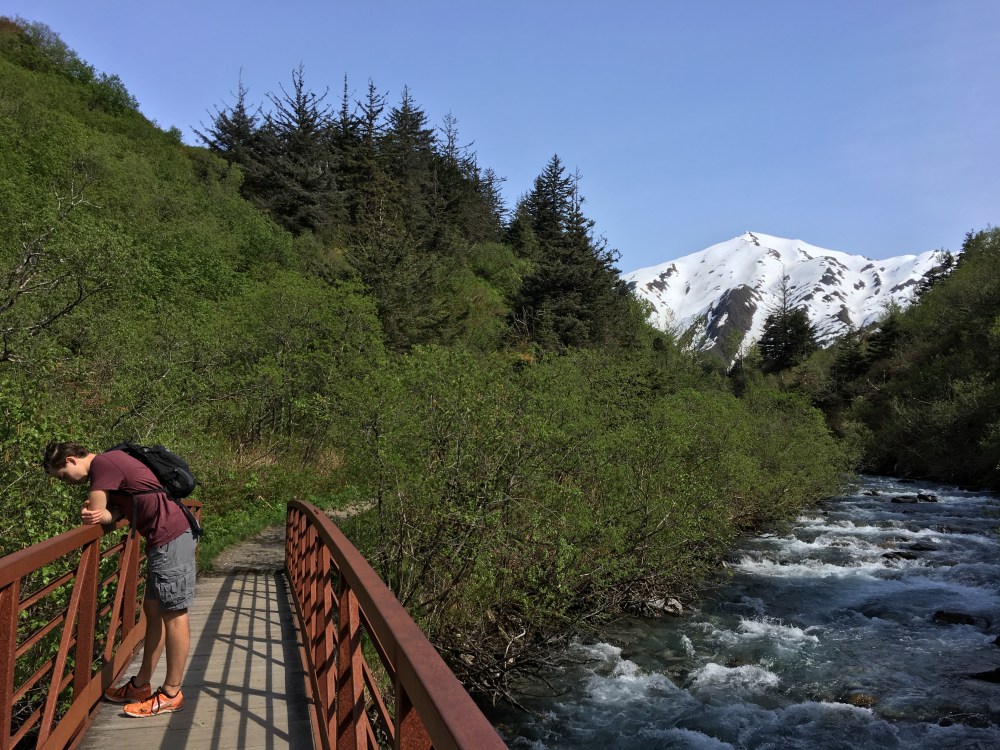
Last Saturday, a few buddies and I decided to go for a hike on a trail called Perseverance.
We walked right beside a snowmelt-fed river for most of the trek, and snowy peaks straight off the side of a National Geographic magazine would poke into view every so often through the lush mountain rainforest in the distance… it’s honestly something you’d think is photoshopped until you’re there. The trailhead is right outside of bustling downtown Juneau, but we might as well have been out in the wilderness once we got hiking! Juneau isn’t a big city — only 32,000 people live in it — and it’s situated in between Mounts Roberts and Juneau to the east, and Gastineau Channel to the west. Having two colossal mountains and the ocean in your backyard makes for great photo opportunities, but it’s forced Juneau to be a pretty geographically skinny place (think of it as a corset for cities). I say all this to make the point that as a city, Juneau is stretched thin; it doesn’t take much to get away from the cute mining-town theme that dominates the front three streets for the tourists that get off the cruise ships. Poorly hidden behind the seafood restaurants and the t-shirt stores, a lot of people are living an impossible struggle. They smear lipstick on the pig of their brokenness every day at work, and drown it again every night just to repeat the cycle the next day. Alaska has the 2nd-highest depression rate in the entire country, and alcoholism rages through the streets. The demon in a bottle has taken captive this beautiful place and its wonderful people. Despite the struggles, there is incredible determination in the people of Southeast Alaska — they are willing to go to one of the toughest places on the planet to live, and make it their home. I mean that when I say it, and it brings me around to the story I want to tell you.
Beauty Rising From the Ashy Knees
We had just gotten back to the bus stop downtown, and my calves felt like they’d been deep-fried in lactic acid. To top it off, my knees were also ashy at a level unseen on a white dude. I was just standing around, trying not to look worn-out, when I heard a voice in a Mexican accent directed my way.
“Hey man — do you have psoriasis?”
It took me a second to mentally register what I had just heard. What? Who on earth is this dude!?! I eventually said something along the lines of “no, but thanks for your concern” as I looked in the direction of the voice. I was surprised to see a flaky skin rash all over his hands and neck. I turned away and quickly asked Siri “what on earth is psoriasis?” out of earshot. She answered me with a picture that closely resembled what I saw on the guy who had just talked to me. Then I heard the chuckles. Apparently, the rest of the group knew what it was, and heard me say it… I’m still getting a hard time about that.
Sooner or later, we were finally able to pile into a bus and head back to the University of Alaska Southeast, where we’re staying for the summer. As I found my seat, I decided to start a conversation with the guy who asked me about psoriasis. I’m not sure how it all started, but it didn’t take us long to start laughing at the weird things that had happened to us during the day. He was an extroverted guy, and he could very easily be a comedian if he wanted a second career. He told me his name (we’ll say it was Miguel for his sake), and we started to dive into a serious conversation. When I asked him what brought him up to Juneau, he said
“Do you want the truth?”
Timidly, I nodded my head yes. What was I getting myself into? I asked myself. At this point, my friend Stephen McLaren had gotten into the conversation with me. Stephen goes to Texas State, but the first thing to know about him is the Texas-sized smile on his face all the time. In the week I’ve gotten to know him, he’s just been a really joyful dude the entire time! Now, as the conversation got a little deeper, I was really grateful to have a guy like him next to me.
Miguel started by telling us that he was from California, and job opportunities brought him up to Juneau. Turns out, he works at Alaska Shirt Company, where Stephen and a few other people from our summer mission had just been hired for the summer. He was an immigrant with family back in Missouri, but had no kids or woman in his life. As we listened, he started to double back and tell us more about his situation in California. Miguel had a rough life; according to his story, he had been arrested on felony charges for unknowingly helping a friend sell a stolen firearm. He did his time, and was released early for good behavior. After he got out, he did his best to live a quiet life – but as he saw the abuse of other immigrants around him, he felt like he had to do something. Living life as an illegal immigrant is a lot like living in the shadows, he told us. Many come up to the US to make money for their families, but the people who provide them shelter and transportation scalp immigrants by charging high prices that they cannot pay – blackmailing them into either getting ratted out to the authorities, or getting forced deeper and deeper into debt. In the end, many immigrants end up so deep in debt that they must stop sending money to their families. Miguel saw this, and did what he thought was right. He and a friend of his bought a van, and started transporting immigrants around the LA area for prices that they could afford. They did this for a while, but were eventually caught, and Miguel was arrested, again. After doing some more time, he was sent to a halfway house in Juneau where he now lives. His schedule is regimented and simple. 80 hours are allowed outside the house — including hours spent working — and the rest are to be spent inside. He has a perimeter that he cannot breach, monitored at all times.
Now, this story is not meant to be a political statement. I don’t even know if all of it is true, but I share it with you to make a point. People like Miguel need hope. People like Miguel are the reason that this Cru Summer Project exists. After we got off the bus, Stephen and I started talking about how we could show Miguel love this summer; Stephen potentially has the chance to be with him 4 days out of the week! I’ll be encouraging him and praying that God will use him to show Miguel that there is something he can hope in – that there is a place for him to go, to a loving Father that will wholly accept him for who he is. His sentence has already been served, forever through the death and resurrection of Jesus. Miguel can find freedom in the word of God:
Jesus answered… “if you abide in my word, you are truly my disciples, and you will know the truth, and the truth will set you free.”
And what is that truth? That yes, God loves us, more than we could ever love him. That yes, we are broken people, living broken lives on a broken planet in rebellion against the God who made us. And despite all that, God’s love didn’t disappear. Instead, he offers to clean up our mess for us. He did that through his son. While we sat on the electric chair of our own brokenness, Jesus suffered the consequence of our own brokenness for us.
“For the joy that was set before him, (Jesus) endured the cross, despising its shame, and is seated at the right hand of God.”
God offers us a way back to himself. Are we willing to reach for the lifeboat?

 Cade Patterson
Keep them coming bud! Glad you’re enjoying yourself!
LikeLiked by 1 person
Thanks! You too dude👍🏼
LikeLike
Great post, Cade! You know God probably gave you those ashy knees so you could meet Miguel…….. just sayin’
Praying for you down here in the lower 48 states! 😀
LDHS graduation is this Wednesday. Lift up those fellow Raiders as they embark on new life journeys.
LikeLiked by 1 person
You’re probably right! Thanks! I’ll definitely be praying👍🏼👍🏼
LikeLike
Awesome stuff Cade! I love reading your blog posts. Praying for ya man!
LikeLiked by 1 person
Thanks dude! You’re a blessing👍🏼
LikeLike
I loved that post and I hope you’re enjoying your time up there! Can’t wait to here more about it! I’m praying for you!
LikeLike
Thanks man! I’m having a great time👍🏼 I’ll keep you in the loop! Thanks for the prayer.
LikeLike